Tuesday, March 28, 2006

Coalition maps spotlighted by Tech Soup


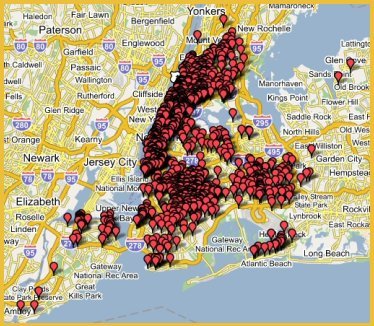
Tech Soup, a technology website for nonprofit organizations, has published a feature story on the New York City Coalition Against Hunger's mapping operations. The interactive maps, which use Google Maps as a framework, show the location of emergency food programs in the five boroughs of New York City.

Friday, March 24, 2006

Controversy over Congressman’s support of food bill

U.S. Rep. Edolphus Towns, who represents parts of Brooklyn, has come under fire for his sponsorship of the National Uniformity in Food Act. The bill, which passed the House Mar. 9, would impose uniform labelling standards. Its opponents include consumer organizations and some state Democrats. Supporters, however, hailed the bill as a victory for consumers.

Demand for emergency food up in United States

Nationally, the demand for emergency food has increased by 8 percent in the past five years, according to a study by America’s Second Harvest. More than 25 million Americans now receive some sort of emergency food at soup kitchens or food pantries.

Thursday, March 16, 2006

Coalition joins advocates, Episcopal Church in calling for state $$ increase

Thursday, March 16, 2006, marked the 16th annual Hunger Awareness Day in New York State. In honor of the day, the Coalition Against Hunger, the Hunger Action Network, Feed the Solution and Episcopal emergency food program staff, clients and clergy called upon the New York State Legislature to increase funding for the Hunger Prevention and Nutrition Assistance Program (HPNAP). HPNAP is the main source of state funding for food banks, soup kitchens, food pantries, and food rescue organizations. Governor George Pataki’s budget proposal would leave food pantries and soup kitchens statewide with two million dollars less in HPNAP funding than at its peak level four years ago, even though the number of people served by such agencies has skyrocketed during the same time period.

Tuesday, March 07, 2006

New data from City shows sharp hike in pantry and kitchen use

Charitable soup kitchens and food pantries that receive some funding from the City of New York provided 172,840 more meals in 2005 than in 2004, according to the first-ever release by the City of two full calendar years worth of such statistics. During the same two year time period, participation in the federally funded Food Stamp Program in the city increased by 141,916-people, providing low-income families with an estimated $170 million in additional federal nutrition assistance. According to Coalition Against Hunger Executive Director Joel Berg, “The only good news is that participation in the Food Stamp Program continues to climb somewhat, providing hungry families much more food than they would be otherwise able to obtain from pantries and kitchens. But as long as pantry and kitchen use continues to soar, our collective work is clearly cut out for us.”

Thursday, February 23, 2006

1 in 5 NYC children in food insecure households


One in five New York City children live in food insecure households, according to New York City Coalition Against Hunger data reported in Spanish-language Hoy. Over 400,000 children in the city live in households where at least one member is going hungry or faces insufficient access to sufficient, nutritious food. And in a Feb. 19 column for the Daily News, Albor Ruiz called on city leaders to gain the political will to put an end to hunger in the country's richest city.

Said Joel Berg, executive director of the Coalition Against Hunger: "When every fifth child in New York City lives in a home that doesn't have enough food, it is clear that New York City is facing a hunger crisis. You could fill Yankee Stadium more than seven times with these children. Such numbers should be a wakeup call for government leaders, business executives and average residents alike."

Brooklyn has few healthy choices

A new study by the Department of Health and Mental Hygiene shows that Central and Northern Brooklyn residents lack access to adequately healthy food options. Bodegas are the dominant form of grocery vendor, and few bodegas offer green leafy vegetables and other important components of a balanced diet. Restaurants offering high-fat foods like pizza and Chinese food are also dominant.

Thursday, February 16, 2006

Mayor steamed by officers' need for food stamps

Officials including Mayor Michael Bloomberg are upset because recently lowered wages for city police officers have prompted some new recruits to apply for food stamps. It appears unlikely that any officers would actually qualify for food stamps.

Even as officials justifiably decry the low wages of police officers, over 1 million other New Yorkers--the majority of whom work long hours like these officers--receive food stamps. An estimated 500,000 to 700,000 New Yorkers qualify due to low wages but do not receive food stamps, often deterred by the difficulty of wrangling with bureaucratic red tape. (Photo courtesy tia.org.)

Friday, February 10, 2006

Got whole milk? Nope

The New York City school system, in a move designed to increase nutritional standards and child health, has moved from providing whole milk to exclusively offering skim and 1 percent varieties. Among flavored milks, only chocolate skim milk will remain. (Photo courtesy USDA.)

The personal side of food stamps access problems

For all the public handwringing and political talk about food stamps access problems and the need to fix the system, the personal frustrations of food stamps applicants are often overlooked. But in hearing personal stories, a consistent thread resounds: navigating a mountain of red tape to feed one’s family “sucks.”

Asking the press to ask about welfare

Joel Berg, executive director of the New York City Coalition Against Hunger, has some questions for the news media to ask about welfare reform. Among them: “Given that poverty, inequality of wealth, hunger, and food insecurity have all increased over the last four years, was welfare reform at least partly to blame for some or all of these increases? Will the further tightening of benefits under the [FY 2006] reconcilliation bill further increase poverty, inequality of wealth, hunger, and food insecurity in America?”

Hunts Point mall stores to allow food stamps


The City Council approved a mall to replace the Bronx Terminal Market at Hunts Point, but not before ensuring that any stores accept food stamps and other food subsidies like those of the Women, Infants and Children program. BJ’s, a wholesale food club almost certain to be a flagship tenant, does not generally accept food stamps but will at the Hunts Point mall. Councilman Hiram Monserrate was among those who pushed for food stamps and WIC, and the guarantee of those programs struck many observers as decent and sensible.

Tuesday, January 24, 2006

Times weighs in on NYC hunger

A much-anticipated Sunday editorial in The New York Times took on the issue of hunger in New York City. The editorial speaks for itself:

What if, before your next meal, you first had to fill out paperwork and then wait hours in a crowded office to be interviewed and fingerprinted? That is not a hypothetical situation for many of New York's working poor--hundreds of thousands of whom are eligible for food stamps but do not get them because of unnecessary bureaucratic obstacles.

Recent studies by the Urban Justice Center and others document how difficult and degrading it can be for the hungry to get help. Despite improvements, like the state-mandated reduction in paperwork, the city still must regain ground lost under Mayor Rudolph Giuliani, who built a wall of red tape to express his distaste for the program.

For many of the working poor, food stamps are a necessity, often the difference between having to decide whether to pay the rent or eat. According to various estimates, New York has effectively turned its back on more than $700 million in federal funds that it would receive if every eligible New Yorker enrolled in the food stamp program. That money would be spent in grocery stores and bodegas, boosting the local economy.

The City Council, led by Bill de Blasio of Brooklyn and Eric Gioia of Queens, has been prodding the Human Resources Administration to accept applications by fax and to allow people to apply online and at food pantries and soup kitchens. The Bloomberg administration should embrace these ideas.

One hopeful sign is Mayor Michael Bloomberg's s appointment of Linda Gibbs to be deputy mayor for human resources. Ms. Gibbs helped shape the city's program for the homeless. It is the city's hungry who now require her attention. She could start by instructing workers to stop fingerprinting every applicant. New York is one of a few states that requires this costly and obstructive process. Hunger is indignity enough.
Monday, January 23, 2006

The budget is in

City budget information is now available in the form of a report. Among the revelations is that the city has allocated $8.4 million for food support in 2006 but will pay only $32,000 of the administrative costs of food stamps. So, it turns out, the Food Stamp Program is not costing New York City much at all.

Friday, January 20, 2006

City Council report on hunger

The New York City Council's report on food stamps access, "Empty Cupboards," provides a bracing look at a system that currently underserves New Yorkers. It is available here.

Thursday, January 19, 2006

Columnist: Political will can end NYC hunger

In a Jan. 19 Daily News column, Albor Ruiz argued that New York City can end hunger if politicians take steps to ensure families get enough to eat. A good start, he writes, would be increasing the percentage of eligible New Yorkers who receive food stamps by implementing several city laws passed this summer. "The failures of welfare reform--as well as continued underparticipation in the Food Stamp Program--in New York City are forcing more people into poverty, hunger and homelessness than into living wage jobs," said Joel Berg, executive director of the New York Coalition Against Hunger.

Tuesday, January 17, 2006

Coalition coordinates MLK Serve-A-Thon

The New York City Coalition Against Hunger coordinated its third annual Martin Luther King Day Serve-A-Thon this weekend, bringing New York volunteers into food pantries and soup kitchens to serve their low-income neighbors and honor Dr. King's legacy. East Side Entrees donated 25,000 breakfasts for children in association with the got Breakfast? campaign, led by former Senators Bob Dole and George McGovern. Volunteer opportunities were available in Manhattan, Brooklyn, the Bronx, and Queens.

School food: C-minus, but looking up

Food may be improving in New York Schools, particularly in terms of nutrition, but students and advocates say it has a long way to go before it reaches quality and taste standards. Progress should be ramped up--the alternatives include paying for lunch, eating unnutritious food, or not eating enough. None of these options are worthy of our children.

Poor neighborhoods faced with junk options

Low-income neighborhoods often get the short shrift when it comes to healthy food options, according to the New York City Coalition Against Hunger and the New Yorkers who live in these neighborhoods.

"Often people buy less nutritious, more fattening food and get fat because it's cheaper to do so," Executive Director Joel Berg said. "People will travel ridiculously long distances to go to farmers' markets, travel long distances to go to supermarkets."

Food stamps need to be accessible, officials say

In light of a City Council investigation revealing accessibility problems for food stamps, anti-hunger advocates and elected officials gathered Saturday to challenge the city to do more to increase food stamps participation. Among the officials were New York City Councilman Eric Gioia, State Senator Liz Krueger, and Assemblyman Felix Ortiz. The City Council passed three bills last summer designed to increase accessibility, but the city's implementation has been slow. In the meantime, families are hurting.